
If you have been trying to get results from search for a while, then you need to think about Google Discover Optimization in 2026. Google Discover Optimization in 2026 is really different from what you’re used to. Google Discover is like a list of things where people see things they might like. It is not like a search engine where people type in questions to get answers. Your Google Discover content has to be good enough to make someone stop looking through Google Discover.
I learned this the way. At first, I was still thinking about keywords as I did for search engine optimization. Then I changed the way I thought about Google Discover Optimization in 2026. I asked myself why someone would stop looking and choose a Google Discover story. After that, everything changed for me.
I worked on a project for Google Discover. It really showed me the difference it can make. A page that was not doing well in search got a lot of attention once it started appearing in Google Discover. That is when I realized that Google Discover Optimization in 2026 needs its own plan. You cannot just use the search engine optimization methods for Google Discover Optimization in 2026.
This guide will show you how to be part of Google Discover based on my experience with Google Discover Optimization in 2026. I will share things that have actually worked for me. Whether you are new to search engine optimization or you have been doing it for a long time, these ideas will help you understand what makes content work well in Google Discover. Google Discover Optimization in 2026 is about making content that gets noticed and builds trust with Google Discover. It is about keeping readers interested in Google Discover. Google Discover Optimization in 2026 is all about Google Discover and how to use Google Discover.
By the end of this guide, you will understand the ideas behind Google Discover Optimization in 2026. You will know the things to avoid and the real methods that can help you appear in the Google Discover list. Google Discover Optimization in 2026 is no longer something you can ignore if you want to get visitors to your website beyond search engine optimization. You need to think about Google Discover Optimization in 2026 if you want to make your website well known. Google Discover Optimization in 2026 is the way to go if you want to find people and get visitors to your website through Google Discover.
Why Google Discover Optimization Is Different From SEO
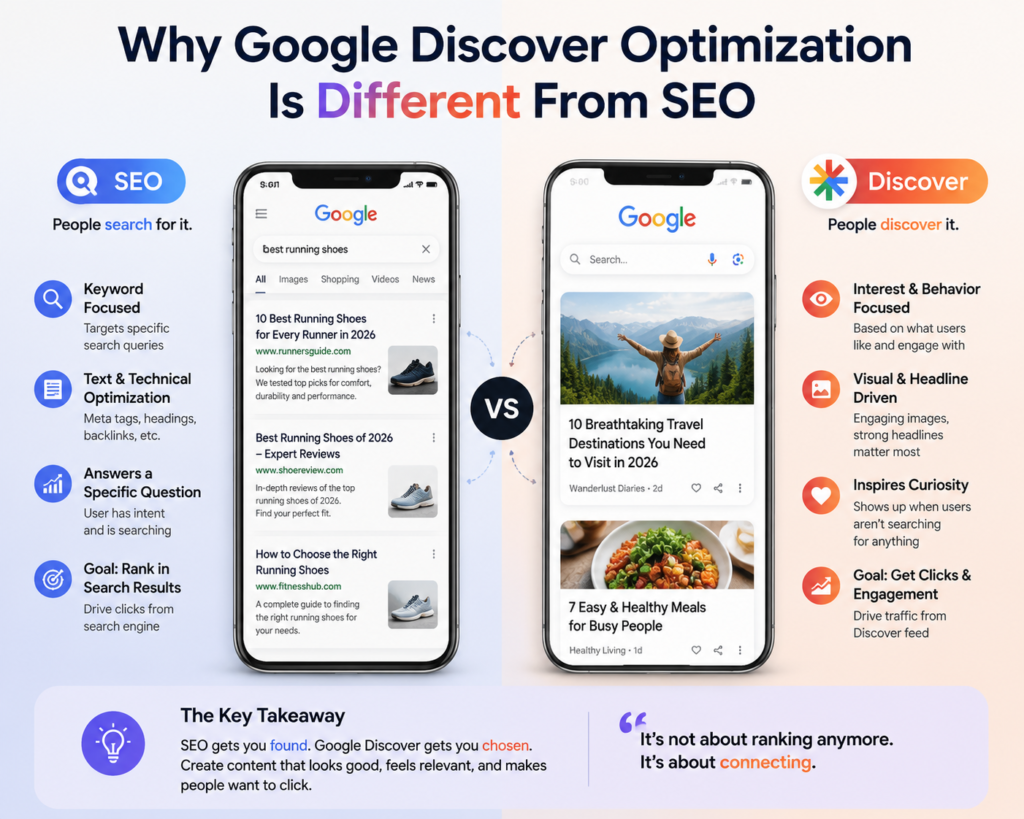
SEO is about answering a question that someone typed into a search engine. Google Discover shows up when someone is not looking for anything. It shows content based on what people like and what they do. When they are active, this means that things like keyword density still matter. They are not the important thing anymore. Visuals, headlines, and how relevant the topic is are more important in Google Discover.
The mistake I often see is businesses treating Google Discover like it is a search engine. They focus much on keywords and have technically good pages but have a boring thumbnail and headline. A page can have all the SEO elements right. It might still get no attention in Google Discover if it does not give someone a reason to stop scrolling.
The Driver: Images That Stop the Scroll
Image choice is probably the factor in how well your Google Discover content performs. Because the image is often the thing someone sees before deciding to click on Google Discover.
Here are some rules I follow for every Google Discover project:
1. Use high-quality images :
Aim for images that’re 1200 pixels wide so they can be shown clearly. Blurry or low-quality images make people keep scrolling.
2. Avoid stock photos :
Images that look the same as every thumbnail in Google Discover tend to do
3. Make the main subject clear :
A viewer should understand the idea in a moment, like an expression, a dramatic moment, or a clear before-and-after in Google Discover.
4. Avoid looking like a design :
Text on top of images, logos, and clickbait-style graphics tends to hurt performance. Images that feel natural and fit the feed perform better.
5. Make sure the image matches the headline:
If the headline creates curiosity, the image should support it. Otherwise, the click-through rate in Google Discover drops.
What works depends on the topic. A beautiful landscape might work for travel content in Google Discover while a strong human face or a moment of action might work better for news or entertainment in Google Discover. Testing formats over time is part of the Google Discover process.
Writing Headlines That Actually Earn Clicks
Google Discover headlines need to act like the start of a story, not like a search result title. One structure that has worked well is creating a headline that focuses on an outcome like “Experts Did Not Expect This Small Change to Have Such a Big Impact. Here’s Why” in Google Discover.
What made that kind of headline work was based on three things:
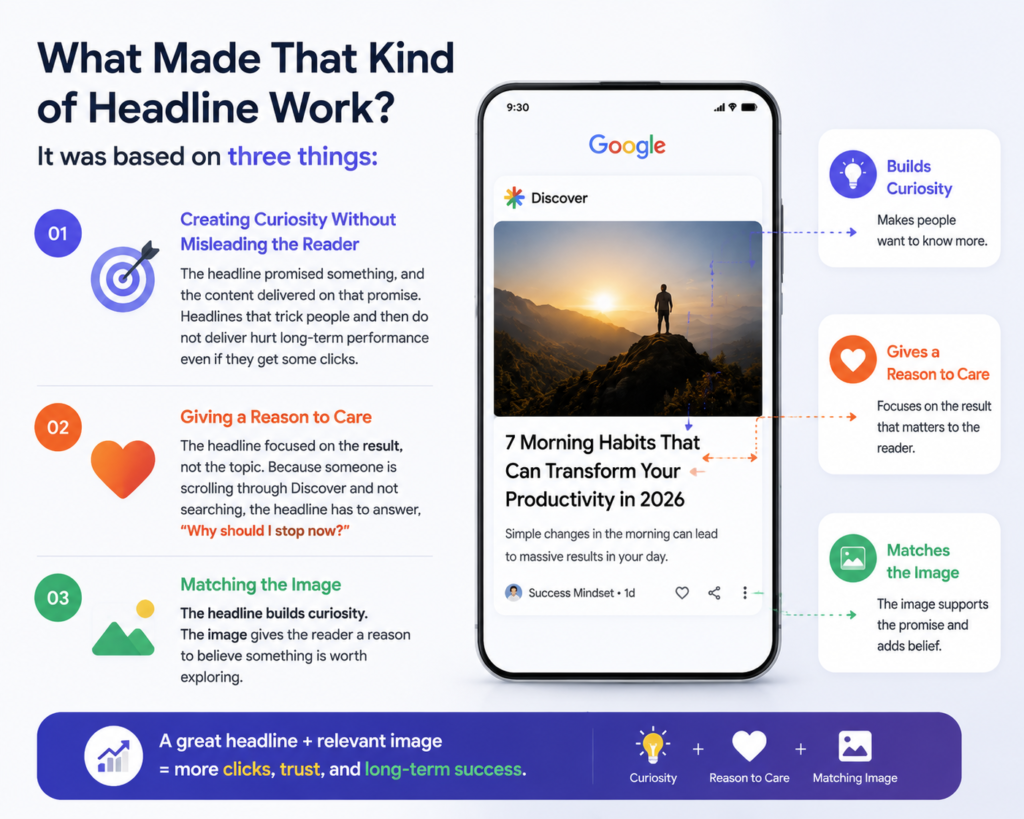
1. Creating curiosity without misleading the reader.
The headline promised something, and the content delivered on that promise in Google Discover. Headlines that trick people and then do not deliver hurt long-term performance even if they get some clicks in Google Discover.
2. Giving a reason to care.
The headline focused on the result, not the topic. Because someone is scrolling through Google Discover and not searching, the headline has to answer, “Why should I stop now?” in Google Discover.
3. Matching the image.
The headline builds curiosity. The image gives the reader a reason to believe something is worth exploring in Google Discover.
The headline still needs to match the content in Google Discover. The goal is to create interest and emotional connection, not just place keywords in Google Discover.
Mistakes to Avoid
Besides treating images and headlines as an afterthought, two common mistakes happen over and over:
1. Publishing content that’s too general or always relevant : Google Discover tends to favour content that feels current and connected to what people’ re interested in. Not chasing every trend. Finding an angle in Google Discover.
2. Not asking the question “Why would someone choose this?”: Technically good content is not enough. Understanding that Google Discover works like a recommendation system, not a search engine, changes the approach: images, headlines, better stories, and a clearer target audience in Google Discover.
A Practical Pre-Publish Checklist for Google Discover
Here is the process I go through before publishing anything that I want to do in Google Discover Optimization in 2026:
Here is the process I go through before publishing anything that I want to do in Google Discover:
Steps and What to Check
Audience & topic fit: Is this really interesting to the target audience now? Is there an angle, not a topic, in Google Discover? Headline review Does it spark curiosity while accurately showing what the Google Discover article is about?
Image optimization: Is it clear, high-quality, big enough, and matches the headline in Google Discover?
Content quality & structure: Does the intro grab attention quickly? Is it easy to read? Does it go beyond a summary in Google Discover?
Technical checks: Is it fast on mobile? Are the metadata and structured data correct in Google Discover?
Post-publish monitoring: Track Google Discover impressions, CTR, and how people interact to improve Google Discover content.
Results can vary a lot depending on the size of the site, the topic, and how well-known it is. Google Discover optimization is not a way to get traffic for every site. When done consistently, this process has taken Google Discover articles from getting attention to getting much more traffic than search alone in Google Discover. The real benefit is not from one Google Discover article; it’s from the process of choosing topics, making them appealing, and understanding the audience in Google Discover.
AI Search Optimization Tips for Businesses in 2026
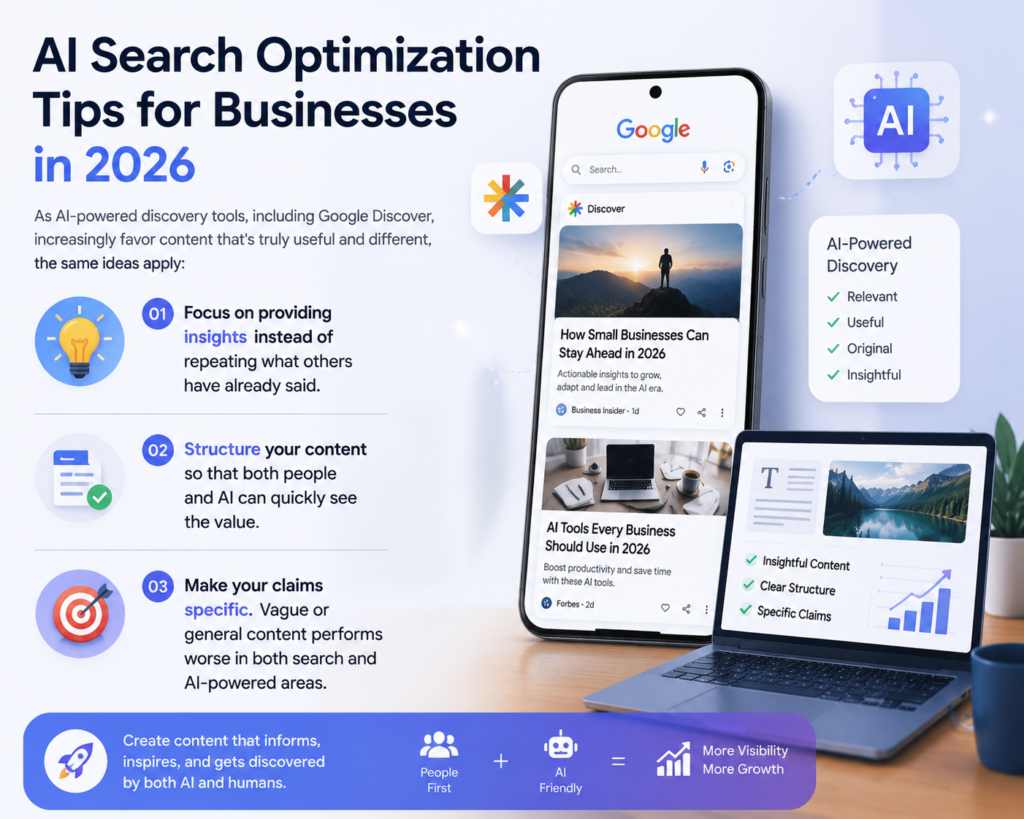
As AI-powered discovery tools, including Google Discover, increasingly favor content that’s truly useful and different, the same ideas apply:
- Focus on providing insights instead of repeating what others have already said in Google Discover.
- Structure your Google Discover content so that both people and AI can quickly see the value in Google Discover.
- Make your claims specific. Vague or general content performs worse in both search and AI-powered areas in Google Discover.
Frequently Asked Questions
Does doing well in Google Search help with Google Discover?
Not always. A page does not need to be at the top of search results to do well in Google Discover. The two are separate in Google Discover.
What image size works best for Google Discover?
Try to use images that’re 1200 pixels. They should have a high-quality subject that’s not a generic stock image in Google Discover.
How often should Google Discover content be updated for Google Discover?
There is no set rule. Content that feels current and relevant tends to do better than static, evergreen content in Google Discover.
Conclusion
Google Discover Optimization in 2026 is not about stuffing keywords or doing what you’d normally do for traditional search engine optimization. It’s about figuring out what makes people stop, look at your content, engage with it, and choose it when they’re scrolling past dozens of other things. You succeed by combining storytelling, compelling headlines, timely topics, and content that genuinely helps the people reading it. That’s why Google Discover Optimization in 2026 requires you to think differently than you do for standard SEO.
The biggest shift is that you need to stop thinking about search and start thinking about the people reading your content. Instead of asking, “How can I get my content to show up?” you should ask, “Why would someone want to see this in their Google Discover feed?” If your content answers that question with strong visuals and stories that resonate, it’s far more likely to appear in people’s Discover feeds. Putting the audience first is a core principle of Google Discover Optimization in 2026.
It can be hard to know exactly how to drive traffic from Google Discover, since there’s no single formula that always works. But if you pick topics people genuinely care about, use large and high-quality images, write headlines that spark curiosity, and consistently monitor how your content performs, you can build a strategy that grows steadily over time. This consistent testing and refinement is what separates real Google Discover Optimization in 2026 from guesswork.
In 2026 and beyond, the brands that succeed will be the ones creating content for people, not for algorithms. Content that teaches, inspires, and captures attention will continue to perform well in Discover. Master Google Discover Optimization in 2026, and you’ll expand your reach, connect with more readers, and drive free, sustainable traffic to your website.